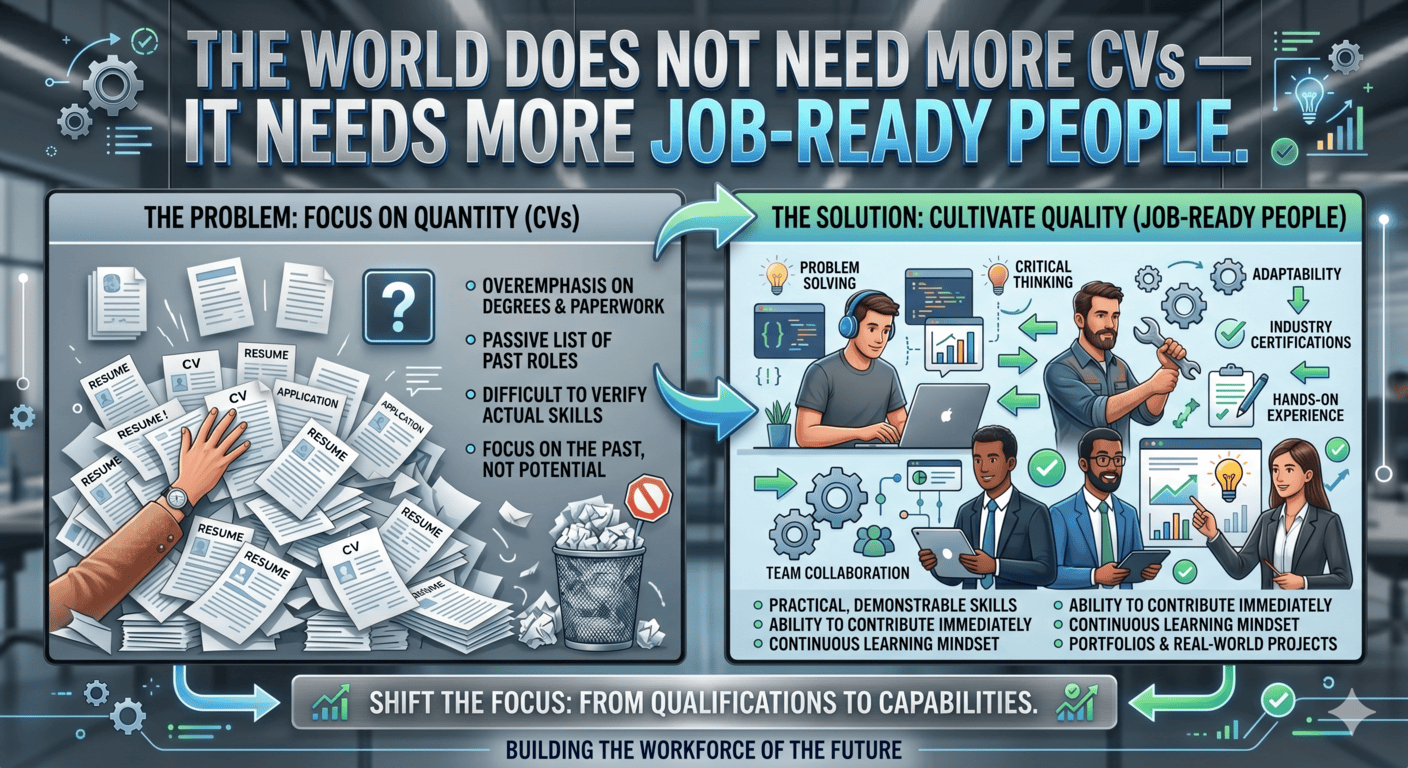
There are more CVs in the world today than at any point in history. Job boards overflow with them. Applicant Tracking Systems are drowning in them. Recruiters spend hours — sometimes days — sifting through them. And yet, despite this abundance of CVs, employers everywhere are struggling to find people who can actually do the job.
The CV has not changed in over 70 years. The job market has. And that disconnect is costing everyone — job seekers, employers, and the broader economy — dearly.
“A CV tells you where someone has been. A skills profile tells you whether they are ready for where they are going.”
The CV Was Built for a World That No Longer Exists
The modern CV format was standardised in the early 1950s, when the post-war economic boom created a surge of white-collar employment in manufacturing, banking, and government. Employers had clear, stable job descriptions. Experience at one company genuinely translated to another. Education was a reliable proxy for capability.
That world no longer exists. Today, job titles evolve faster than organisational charts. A “Marketing Manager” in 2015 bears little resemblance to one in 2025. Tools change every three to five years. Entire skill sets become obsolete; new ones emerge from nowhere. And yet the CV — that two-page document listing where you worked and when — remains the primary selection filter for most hiring processes in the world.
It is a relic of a hiring system designed for a world of stable jobs, predictable careers, and skills that lasted a lifetime. None of those conditions apply in 2025.
What Employers Actually Need — And Cannot Get From a CV
Ask any hiring manager what they want from a new hire and you will not hear “someone with a well-formatted CV.” You will hear: “Someone who can hit the ground running.” Or: “Someone who can prove they can do the work — not just say they can.”
These are not unreasonable expectations. But CVs are spectacularly bad at answering them. The format rewards people who are good at writing CVs, not people who are good at doing the job. It creates a fundamental information asymmetry: the applicant knows exactly what they are capable of; the employer can only guess.
The research is damning. A global survey of 4,200 hiring managers found that 78% had experienced significant skill mismatches in recent hires — people whose CVs looked excellent but whose actual capabilities fell short. The cost of a bad hire averages 1.5 to 3 times the departing employee’s annual salary (CIPD, 2023). Employers invest hours trying to close the information gap through interviews, references, and instinct — all of which are far less accurate than most hiring managers believe.
of hiring managers report significant skill mismatches in recent hires
average cost of a bad hire versus employee annual salary (CIPD)
reduction in time-to-hire reported by employers using skills-based hiring
How AI Is Transforming Recruitment — For Better or Worse
There is a popular narrative that AI in recruitment is primarily about sorting CVs faster. Feed a machine learning model thousands of past CVs, train it on what successful hires looked like, and let it pre-filter the pile automatically. This narrative misses the point — and potentially makes the original problem significantly worse.
If AI is simply optimising the CV-reading process, you are automating the wrong thing. You are creating a faster, more efficient version of a fundamentally broken system. Worse, AI trained on historical hiring data perpetuates historical biases at scale — invisibly and systematically, without any of the human accountability that previously checked them.
The real opportunity for AI in recruitment is not faster CV processing. It is replacing the CV altogether. AI can assess skill. AI can verify competency. AI can conduct structured, evidence-based interviews at scale. It can identify the specific gap between a candidate’s current capability and a role’s actual requirements — not by reading self-written claims, but by testing them in real time.
This is the shift from CV-based hiring to skills-based hiring. And it changes everything.
The Job Market Has Changed. Your CV Is No Longer Enough.
Why skills-based hiring is the most important shift in recruitment in a generation — and what it means for you.
Brand Film · 60–90 seconds
The Skills Gap Crisis Is Real — and Getting Bigger
Here is a paradox that keeps economists awake at night: we have record unemployment coexisting with record numbers of unfilled roles. The World Economic Forum estimates that over one billion jobs will be transformed by technology in the next decade. The skills required to fill those roles do not match what most workers currently have — and the gap is widening.
The traditional upskilling model is broken. A worker decides to upskill, randomly picks a course that looks impressive, completes it, and hopes it somehow improves their job prospects. There is no signal. No feedback loop. No clarity about what is actually needed for a specific role. And on the employer side, there is no way to see the investment the candidate made — their CV still looks the same as it did before they spent three months learning.
What “Job-Ready” Actually Means in 2025
Job-readiness is not about having a degree or an impressive list of job titles. It is about having demonstrable, verified, current capability to perform the specific tasks required by a specific role. It breaks down into four dimensions:
Verified skills, not claimed ones. Not “I know data analytics” — but “I completed a data analytics assessment and scored in the 87th percentile.” Verified skills replace subjective self-assessment with objective, standardised evidence. Anyone can claim a skill; far fewer can demonstrate it.
Current certifications. Industry certifications signal that someone has invested time and effort to meet an external standard — not a degree from fifteen years ago, but a relevant certification completed in the last twelve months, issued by a credible organisation.
Role-specific alignment. Job-readiness is not absolute. Someone can be perfectly ready for one role and completely unprepared for another. The key is knowing which skills a specific role requires, measuring how a candidate compares, and identifying the precise gap between the two.
Learning velocity. In a world where skills evolve constantly, the willingness and ability to close gaps is itself a core competency. Job-readiness includes not just current skills, but a demonstrated pattern of continuous, targeted development.
The New Recruitment Workflow
Forward-thinking companies are already rearchitecting their hiring processes around job-readiness rather than CV-sorting. The new workflow looks fundamentally different from what most organisations currently do — and the results are dramatically better.
In this model, the job posting is not just a description — it is a skills specification. The AI screening layer does not read CVs; it compares verified skills profiles against that specification and instantly identifies the best-matched candidates. The assessment stage validates that candidates can actually perform the core tasks of the role. The AI interview explores how they think and communicate. And the human hire decision is made with evidence, not instinct.
Companies using this approach report 60% reductions in time-to-hire, 40% reductions in cost-per-hire, and significantly higher performance ratings for new hires in their first ninety days. These are not marginal improvements. They are structural ones — the result of fixing the right problem.
How Hiup Closes the Gap
Hiup was designed from the ground up to make job-readiness the centre of gravity for both recruitment and career development. Not as a feature — as the entire operating model.
For employers, Hiup replaces the CV-sorting workflow entirely. You post a role with a skills specification; Hiup’s AI instantly ranks every applicant by their verified skills match score — not by how their CV reads. Candidates are assessed, interviewed by AI, and shortlisted automatically. The recruiter arrives at their desk to a ranked shortlist with AI interview reports ready to review.
For job seekers, Hiup does something no previous job platform has done: it tells you exactly where you stand and precisely what to do to improve. Instead of blindly applying and wondering why you hear nothing back, you can see your job readiness score for any specific role, identify the exact skills you are missing, and take a free certified Hiup course to close that gap. Your score updates in real time as you earn each certification.
Software in Your Pocket. Calm in Your Mind.
A day in the life of a job seeker using Hiup — from spotting a gap to landing an offer.
Brand Film · 30–45 seconds
The Hiup Skills-to-Jobs Loop
The most powerful aspect of the Hiup model is not any single feature. It is the closed-loop system that connects skill development directly to job outcomes — and job outcomes back to further skill development. It is a flywheel that accelerates with every turn.
This loop works in both directions. When an employer updates their job specification — adding a new required skill, for example — every job seeker with a matching profile is immediately notified. They can take the relevant Hiup course, earn the certification, and watch their match score update in real time. Learning leads to matching. Matching leads to hiring. Hiring leads to growth. Growth reveals new goals. And the loop begins again.
What You Can Do Today
The shift from CV-based to skills-based hiring is already underway. The question is not whether it will happen — it is whether you will be ready when it does.
If you are a job seeker: Stop optimising your CV and start building a verified skills profile. Identify the two or three specific skills separating you from your dream role. Take a targeted course. Earn the certification. Apply with evidence, not just claims. The employers who matter are ready to see it.
If you are a recruiter or hiring manager: Audit how much time your team spends reviewing CVs that tell you nothing useful. Move to skills specifications for your next role. Let AI handle the screening, assessment, and first-stage interviews. Save human attention for the decisions that genuinely require it.
If you lead a company or organisation: Invest in understanding the skills your people already have and the skills your future roles will require. Build upskilling pathways that connect directly to career progression. Partner with platforms that close the loop between education and employment.
For Job Seekers
Build your verified skills profile and find roles that match your actual ability — free, always.
For Recruiters
Post your first job free and let AI screen, assess, and interview every candidate automatically.
For Companies
See how Hiup’s enterprise skills platform transforms hiring and upskilling at scale.
The world does not need more CVs. It needs a better system — one where skill is visible, learning is rewarded, and hiring is evidence-based. That system is live today. It is called Hiup.
Free for job seekers, always. Start at app.hiupapp.com.